
Cell geometry must suit the measuring range; an unsuitable cell reduces resolution or linearity.
ABB Continuous Water Analysis
Conductivity
From ultrapure water resistivity to concentrated solutions. Cell constant, geometry, temperature and coating are integral to the measurement.
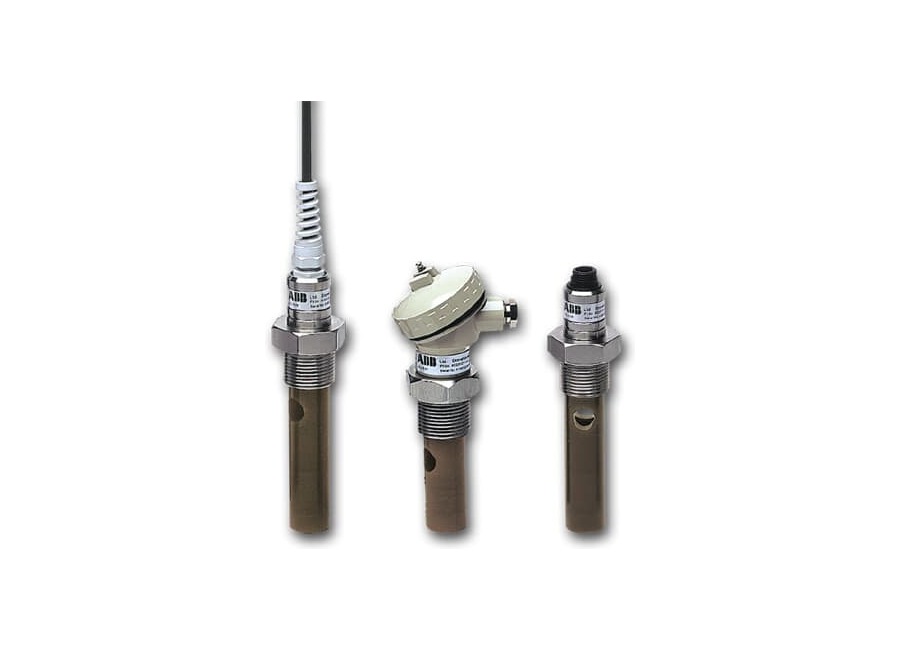
Three measurement principles
2-electrode · 4/6-electrode · electrodeless
ABB covers trace conductivity in ultrapure water up to approximately 2.000 mS/cm using multi-electrode or toroidal technology. The choice depends on the range and the fluid’s tendency to polarise or foul the electrodes.
2-electrodeµS/cm / high purity
4/6-electrodeWide range
ToroidalAggressive fluids / coating
ACA5922-wire Ex/HART
When to use it / when to consider alternatives
Practical guidance
A good fit when
- 2-electrode cells for ultrapure, demineralised and rinse water
- 4/6-electrode cells for wide ranges and high conductivity in mS/cm
- toroidal sensors for coating, corrosive or dirty fluids
- ACA592 when 2-wire/HART operation and hazardous-area installation are required
Consider carefully when
- toroidal sensors for very low trace conductivity
- a cell constant unsuited to the range
- bubbles or a partially uncovered cell
- generic temperature compensation for non-linear chemical behaviour
Best practice
Installation and maintenance
Compensation only works if the measured temperature truly represents the measurement point.
Even small bubbles in high-purity flow cells can dramatically affect the reading.
Electrical noise and ground loops are particularly noticeable at low conductivity.
Remove coating from contacting cells without changing the electrode surface or geometry.
Toroidal measurement is immune to electrode polarisation, but heavy fouling or a partially obstructed bore still affects the reading.
Best to know
Useful technical details
ABB 2-electrode cells
ABB typically specifies up to 10.000 µS/cm: this is the principal technique for trace conductivity.
ABB 4-electrode cells
Ranges reach approximately 2.000 mS/cm, suiting high-conductivity and coating applications.
Electrodeless
Two toroids induce and detect current in a loop of solution, with no exposed metal electrodes.
Hygienic / high pressure
The ABB range includes Tri-Clamp and hot-tap/high-pressure cells for specialist applications.
Models and installed base
Models we support
AC211/212/213AC221AC21AC22TB254TB26TB264TB47TB404/451/454/456/457/461/464/465/468TB82TCTB84TCACA592
ABB documentation
ABB datasheets and manuals
Download the documents for your model. Shared manuals, protocols and versions are identified in each document card.
AC200 · AC211 / AC212 / AC213 / AC221
Datasheet and installation guide for the two-electrode cells.
TB2CS · two electrodes
TB254, TB264, TB26 and TB27 family. Check the full code, cell constant and mounting arrangement.
TB4CS · four electrodes
TB451, TB454, TB457, TB461, TB464, TB465, TB468 and TB47 family, depending on version.
TB404 · toroidal
Sensor without electrodes in contact with the fluid.
Endura ACA592
Separate manuals for two-electrode, four-electrode and toroidal inputs; select the manual for the installed version.
Request a quotation
Conductivity
Technical FAQ
Frequently asked questions
2-electrode or toroidal?
A contacting 2-electrode cell is normally used for ultrapure water and low conductivity. Toroidal sensors suit high conductivity, aggressive fluids and coating applications.
When should I use 4 electrodes?
For a wide range or high conductivity: multi-electrode technology reduces polarisation and coating effects compared with a simple 2-electrode cell.
Is temperature compensation always the same?
No. Pure water, NaCl, acids/bases and other processes have different coefficients. Select an algorithm appropriate to the fluid.
Why is the conductivity reading zero or unstable?
Possible causes include bubbles, an uncovered cell, cable or grounding problems, an incorrect cell constant, missing temperature measurement or an incompatible range.
Can I measure pharmaceutical WFI/PW?
Yes. ABB offers trace-conductivity solutions with reference to USP <645>. The system must still be correctly configured and validated.