
Chlorine decays: a long sample line may give a lower chlorine reading than the process.
ABB Continuous Water Analysis
Chlorine and disinfectants
Chlorine measurement involves more than calibrating a sensor: pH, flow, sample delay, fouling and the chemical form of the oxidant all affect the result.
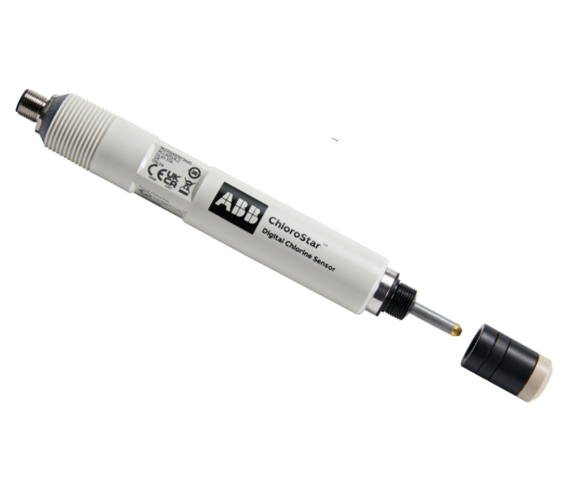
ChloroStar™
ACL420 Sensor / ACL410 Cell
Two complementary approaches: ACL420 a digital three-electrode membrane sensor for free/total chlorine and low-flow applications; ACL410 a self-cleaning open cell for heavily fouling samples and chlorine dioxide.
0–20 mg/LSensor / Cell
pH 4–11ACL420
60–75 L/hACL410 Cell
ATEX/IECExACL420 configurations
When to use it / when to consider alternatives
Practical guidance
A good fit when
- ACL420 for drinking water, distribution and low-flow applications
- ACL410 Cell for wastewater and fouling applications
- ACL421/ACL411 panels for ready-to-integrate, factory-tested assemblies
- AWT420 when dual PID control and an associated pH measurement are required
Consider carefully when
- unstable sample flow
- pH outside the technology’s operating range without compensation or buffering
- long sample lines with chlorine decay
- unmanaged membrane or electrode fouling
Best practice
Installation and maintenance
Stabilise the flow and check the low-flow alarm.
Measure and compensate when the process varies; account for the HOCl/OCl− balance.
Provide a verification sampling point close to the online analyser.
Reduce and stabilise pressure before the cell or panel.
Membranes, electrodes, buffer and cleaning components must be accessible without disturbing other channels.
Best to know
Useful technical details
ACL420
Digital sensor for free/total chlorine, 0–20 mg/L, sample pH 4–11, with low-flow capability.
ACL410
Self-cleaning, flow-through open cell, suited to fouling samples; measures free chlorine, chlorine dioxide and total chlorine under the appropriate conditions.
ACL421
Digital sensor panel with AWT420 and InFlow multi-cell; can integrate pH and dual PID dosing control.
ACL411
Cell panel for fouling samples, with pressure regulator and optional buffer system.
ACL421 Sensor Panel
Factory-tested panel with AWT420, InFlow multi-cell, flow control/alarm, grab sampling and pressure/pH options. Very low sample flow is possible with the appropriate configuration.
ACL411 Cell Panel
Panel with ACL410 and AWT420 for fouling samples, with pressure regulation, pH compensation and an optional buffer pump for total chlorine.
Models and installed base
Models we support
ACL410ACL411ACL420ACL421AWT420InFlow Multi-Cell
ABB documentation
ABB datasheets and manuals
Download the documents for your model. Shared manuals, protocols and versions are identified in each document card.
ACL420 · ChloroStar Sensor
Digital sensor documentation.
ACL410 · ChloroStar Cell
Documentation for the free and total chlorine cell.
ACL421 · Sensor Panel
Panel installation instructions. Also refer to the ACL420 and AWT420 manuals for operation and configuration.
ACL411 · Cell Panel
Panel installation instructions. The Italian datasheet is rev. A (10.2025), earlier than the English rev. B (06.2026). Also refer to the ACL410 and AWT420 manuals.
AWT420 · panel transmitter
Transmitter manual shared by the ChloroStar panels, depending on configuration.
Request a quotation
Chlorine and disinfectants
Technical FAQ
Frequently asked questions
ChloroStar Sensor or Cell?
ACL420 Sensor suits drinking water and low flow, with free/total chlorine measurement and pH 4–11. ACL410 Cell is self-cleaning and particularly suited to wastewater and fouling samples.
Does pH affect free chlorine measurement?
Yes. The HOCl/OCl− distribution changes with pH. At high or variable pH, compensation or buffering must match the measurement technology.
How much flow does the ChloroStar Sensor need?
ABB specifies >1 L/h with the appropriate configuration; the Steady Flow module is used below approximately 10 L/h. ACL410 Cell typically operates at 60–75 L/h.
Are reagents required?
The digital sensor is membrane-based and reagent-free. The Cell may require buffer for total chlorine or for high or variable pH conditions.
Why does a chlorine analyser drift?
Besides calibration, common causes include flow, pH, membrane/electrode condition, fouling, sample delay and temperature.