
Storage and maintenance must preserve the membrane and reference junction as specified.
ABB Continuous Water Analysis
pH and ORP
Continuous pH and redox measurement from municipal water to industrial processes and ultrapure water. Sensor selection depends on conductivity, fouling, temperature, pressure and the risk of reference poisoning.
Application-led pH portfolio
100 / 500 / 700 Series
ABB groups its pH/ORP sensors by application: 100 Series for general and low-conductivity applications, 500 Series for demanding industrial processes and 700 Series for specialist high-purity applications. Analogue and EZLink digital versions are available.
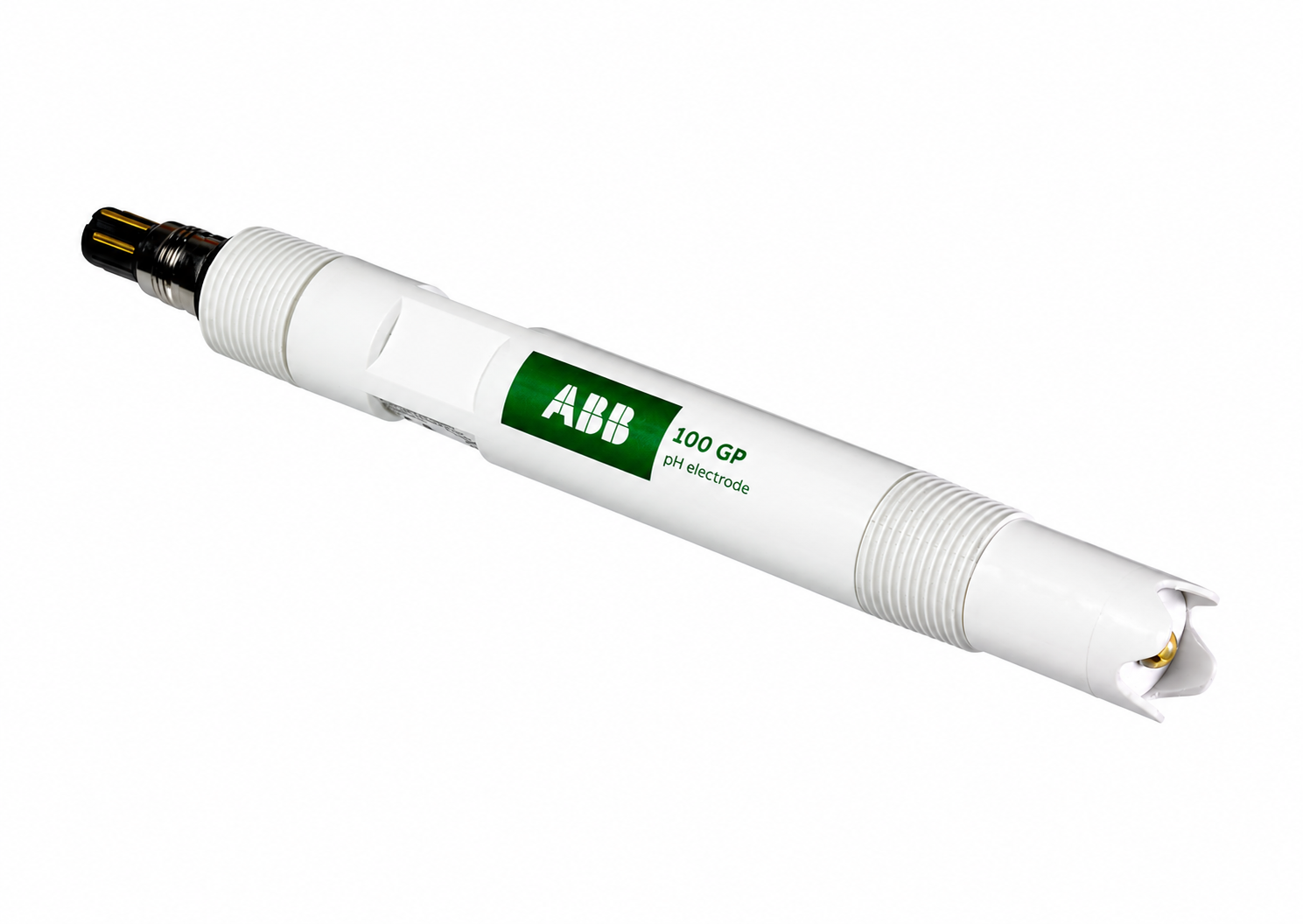
100 GPWater / wastewater
100 ULTRALow conductivity
500 PROHarsh processes
700 ULTRAUltrapure water
When to use it / when to consider alternatives
Practical guidance
A good fit when
- drinking water, wastewater and cooling water → 100 GP
- boiler, deionised and RO water → 100 ULTRA or 700 ULTRA
- industrial processes with poisoning or fouling → 500 PRO / 500 X
- diagnostics and plug-and-play connectivity → EZLink digital version
Consider carefully when
- very low-conductivity samples with a general-purpose sensor
- allowing the electrode to dry out
- heavy coating or poisoning without a cleaning strategy
- bubbles in the flow cell or an unrepresentative sample
Best practice
Installation and maintenance
Use traceable, uncontaminated buffers that preferably bracket the operating range.
Bubbles on the membrane or reference junction generate noise and offset.
Do not use solvents or abrasives that damage the glass, O-rings or junction.
Ultrapure water requires specific flow, grounding and reference-system arrangements.
Check that the temperature sensor is immersed in the same sample and responds quickly.
Best to know
Useful technical details
100 GP
ABB positions it for drinking water, municipal wastewater, cooling water and food and beverage applications; the digital version adds EZLink and diagnostics.
500 PRO
Triple junctions, ion traps and chemical protection increase resistance to reference poisoning in demanding applications.
700 ULTRA
Reservoir-fed/flowing reference for high stability in ultrapure water, where conductivity can be extremely low.
500 X
New addition to the 500 Series for very demanding industrial applications; consider it when pressure, temperature and fouling exceed the typical 500 PRO operating envelope.
Models and installed base
Models we support
APS110APS121APS122APS131APS132APS521APS522APS551APS552APS731APS732AP12AP100AP121TB(X)551/556/557/561/564/567
ABB documentation
ABB datasheets and manuals
Download the documents for your model. Shared manuals, protocols and versions are identified in each document card.
100 E · APS110
12 mm analogue pH/ORP sensor.
100 GP / GP-D · APS121 / APS122
Separate datasheets for analogue and digital sensors; shared manual for the 3/4 in. probes.
100 ULTRA / ULTRA-D · APS131 / APS132
Low-conductivity probes, with separate analogue and digital datasheets.
500 PRO / PRO-D · APS521 / APS522
Probes for industrial applications; select the datasheet for the output type.
500 X / X-D · APS551 / APS552
Probes for severe conditions. Manual OI/100/500 includes the 500 X family.
700 ULTRA / ULTRA-D · APS731 / APS732
Dedicated manual for the 12 mm probe with flowing reference.
Accessories · panel and flow chamber
ABB documentation for installation of the 700 ULTRA probes.
Request a quotation
pH and ORP
Technical FAQ
Frequently asked questions
100 GP, 500 PRO or 700 ULTRA?
100 GP is the general-purpose choice for drinking water, wastewater and cooling water; 500 PRO is intended for more aggressive or fouling industrial processes; 700 ULTRA specialises in ultrapure water and very low conductivity.
Why is pH difficult to measure in ultrapure water?
Very low conductivity makes the signal more sensitive to noise, the reference junction, flow and contamination. A dedicated sensor and flow cell are required.
Does temperature compensation correct the process pH?
It compensates for the electrode’s electrochemical response; it does not automatically make samples at different temperatures comparable if the actual process chemistry changes with temperature.
How often should I calibrate a pH sensor?
There is no universal interval. Set it according to drift, criticality, process conditions and history. Digital diagnostics can help move from scheduled to condition-based maintenance.
Can I let a pH electrode dry out?
No. Maintain the membrane and junction according to the sensor instructions; drying can cause a slow or unstable response.
What does APS521 identify?
It is a code in the ABB 500 PRO analogue family. We check the full code for replacement, because glass, body, connection and cable affect the configuration.