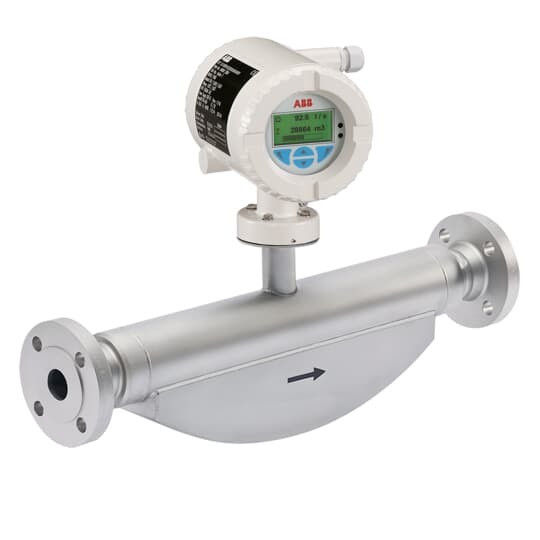
For applications where direct mass flow, density, concentration and repeatability matter more than initial cost alone. Measures liquids and gases without requiring conductivity or external pressure and temperature compensation to calculate mass flow.
A higher-accuracy version for dosing, batching and applications where density and repeatability are critical. Functions such as DensiMass and FillMass are available depending on configuration.
Direct mass flowThe measuring tube detects mass flow directly. Density and temperature are additional measurements available from the same platform.
Low flow / batchingA key strength of Coriolis measurement, although correct zeroing, mechanical stability and sensor sizing become essential at very low flow rates.
When we recommend it
Dosing, batching, filling and mass balances.
Density or concentration measurement alongside flow.
Non-conductive liquids where electromagnetic meters cannot operate.
Gases requiring accurate mass flow measurement where pressure loss is acceptable.
Food and pharmaceutical applications with the hygienic FCH family.
When to assess alternatives
Large pipe diameters and simple water measurement: an electromagnetic meter is often more economical.
Processes with a large, variable amount of entrained gas in the liquid.
Severe mechanical vibration that cannot be mitigated.
Applications where the available pressure cannot accommodate the sensor pressure loss.
Simple applications where density and mass flow add little value.
Best practice
Achieving the specified accuracy
ZeroingPerform zero adjustment with the sensor completely full, no actual flow and stable operating conditions.Pipe supportDo not allow the sensor to carry pipe weight, misalignment or mechanical stress.VibrationKeep the sensor away from strong vibration sources. Consider a remote transmitter and dedicated supports if required.OrientationLiquids, gases and slurries may require different orientations to avoid gas pockets or solids accumulation.Two-phase flowCheck valves, pumps and pressure conditions to avoid flashing, cavitation or entrained gas.Pressure lossDo not size for accuracy alone: always check pressure loss at maximum flow.
ABB replacements
MassMaster / FCM2000 installed base
ABB FCM2000ABB MS2ABB MC2ABB MassMaster
For a replacement, we need the code, nominal size or sensor tube, materials, mass flow range, density, pressure, temperature, flanges and required functions. Migration to FCB or FCH requires configuration, not just a matching name.
ABB documentation · Flow
ABB datasheets and manuals
Download model-specific PDFs with language and revision details. Shared manuals and commissioning instructions are identified in the document cards.
FCB130 / FCB150 · FCH130 / FCH150
CoriolisMaster FCB100 / FCH100 family: process and hygienic versions.
The more details you provide, the sooner we can select the right technology and nominal size.
Technical FAQ
Frequently asked questions
When should I choose a Coriolis meter?
When direct mass flow, high repeatability, density or concentration, batching or dosing, or measurement independent of fluid conductivity is required.
FCB130/150 or FCB430/450?
The 100 families are compact; the 400 families offer a more comprehensive platform with integration and diagnostic options. Consider the 150/450 versions when accuracy is the priority.
What is the difference between FCB and FCH?
FCB is the process family; FCH is the hygienic variant for food and pharmaceutical applications.
Are straight pipe runs required?
Coriolis meters do not require the long straight runs typical of some other technologies. They must still be installed without pipe stress and away from excessive vibration.
Why is zero adjustment important?
Correct zeroing, with a full sensor and genuinely stationary fluid, reduces error, particularly at low flow rates.
Are Coriolis meters affected by bubbles?
Yes. Entrained gas in liquids or two-phase flow can significantly degrade density and mass flow measurements, although some diagnostics help identify the condition.
Is it always better than an electromagnetic meter?
No. For straightforward conductive water applications, especially at large diameters, an electromagnetic meter can be less expensive and have lower pressure loss.