
An oversized valve uses little stroke and worsens resolution, stiction and control stability.
Control valves · multibrand
Regulating, control and safety valves
A valve is not selected by pipe diameter alone. Effective process control requires sizing, valve authority, characteristics, trim, actuator selection and checks for cavitation, flashing, choking and noise.
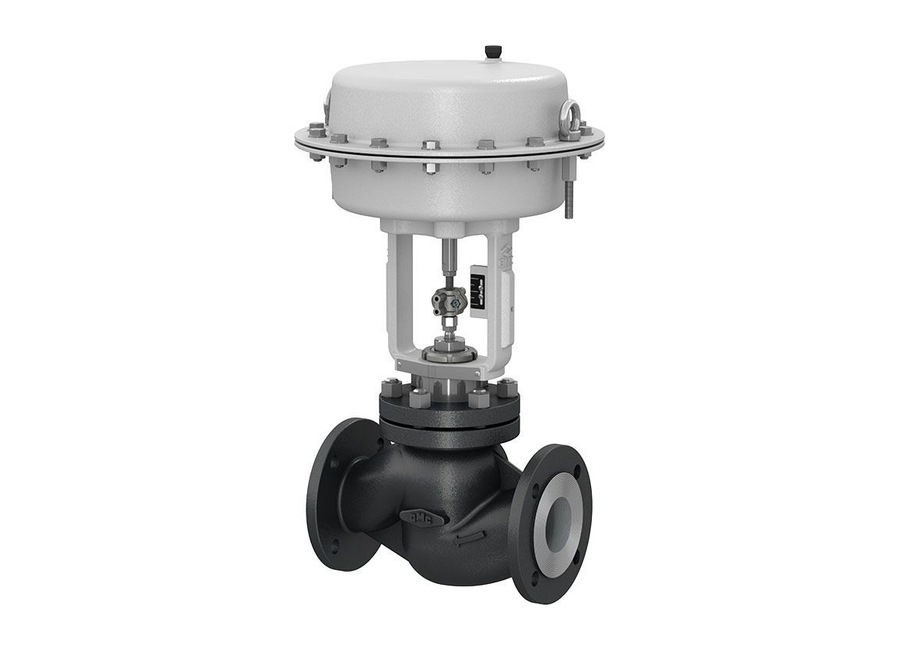
Before Cv
Size the valve for actual operating conditions
Maximum flow is not enough. We assess minimum, normal and maximum flow, upstream/downstream pressure, temperature, fluid properties, vapour pressure, pipe size and class, shut-off pressure, allowable noise and leakage requirements.
Cv / KvRangeabilityCavitationFlashingNoiseLeakage class
When to use it / when to consider alternatives
Globe, ball or butterfly?
| Type | Strengths | Consider |
|---|---|---|
| Globe / angle | Precise modulation, high differential pressures, anti-cavitation or low-noise trims and broad material choice. | Greater cost, weight, space requirements and pressure loss. |
| Segmented / control ball | High capacity, good rangeability, dirty-fluid capability and compact dimensions. | Seat and trim selection, torque, cavitation and shut-off. |
| Control butterfly | Large diameters, low weight and cost, and high capacity. | Authority, cavitation and noise at high differential pressures, and control near closure. |
| Safety / relief | Overpressure protection. | Not a control valve: sizing, set pressure, backpressure and applicable standards form a separate discipline. |
Best practice
Six points that change loop behaviour
The installed characteristic also depends on pressure loss elsewhere in the system, not just the trim.
The worst cavitation or noise case may occur below maximum flow.
The actuator must overcome process forces, friction and shut-off pressure with margin while maintaining the required fail action.
Air quality, tubing and pneumatic capacity affect actual valve speed.
Reducers, elbows, pipe strain and supports can introduce vibration, noise and body loads.
Typical problems
Cavitation, flashing, choking and noise
Cavitation
Local pressure falls below vapour pressure and then recovers. Collapsing bubbles cause noise, vibration and erosion. Multistage or anti-cavitation trim, or redistribution of differential pressure, may be required.
Flashing
If downstream pressure remains below vapour pressure, bubbles do not recondense. High-velocity erosion becomes the main concern, making geometry, materials and velocity control critical.
Choked flow
Beyond a certain differential pressure, flow no longer increases proportionally with available pressure. Sizing must use the appropriate liquid or gas equations.
Aerodynamic noise
For gases and steam, noise may become the design limit. Low-noise trim, staged pressure reduction, diffusers and pipe schedules can affect the result.
ABB Kent Taylor · installed base / spare parts
Older Kent Taylor valves are not presented as a current range. Geyser IC supports sourcing spare parts, trims, packing, diaphragms and actuator parts, and identification from older drawings or codes. If parts are unavailable, we assess retrofits or multibrand replacements against Cv, class, materials, face-to-face dimensions and safety function.
Request a quotation
Sizing and quotation data
Technical FAQ
Control valve FAQ
How is a control valve sized?
Provide fluid, minimum/normal/maximum flow, upstream/downstream pressure, temperature, density, viscosity, vapour pressure, pipe size and class, and shut-off conditions. Cv/Kv is only one result.
Globe or rotary control valve?
Globe valves are often preferred for fine modulation, high differential pressures and a broad trim selection. Ball and butterfly valves suit high capacity, compact installations or large pipes.
Are cavitation and flashing the same?
No. In cavitation, bubbles formed in the trim collapse downstream, causing erosion and noise. In flashing, pressure remains below vapour pressure and the vapour phase persists.
Why does an oversized valve control poorly?
It operates too close to the seat, increases sensitivity to stiction and deadband, and reduces the stroke actually used by the loop.
Equal-percentage or linear characteristic?
Select the inherent characteristic together with plant dynamics. Equal-percentage is common where available pressure drop changes with flow.
How do I choose fail-open or fail-closed?
It depends on the safe process position following loss of air or signal. Define it through process safety and HAZOP, not mechanical preference.
Do you supply Kent Taylor spare parts?
Yes. With a nameplate, serial number, drawing or old part number, we can source parts, trims, packing and diaphragms, and assess retrofits or replacement.