
PGS100 / PGP100 / PGF100
P-100 family datasheet. Separate HART and IO-Link manuals.
Geyser IC is an authorised ABB Value Provider / Channel Partner for Measurement & Analytics. We help select the right platform for budget, accuracy, certifications, protocol, industry and process conditions.
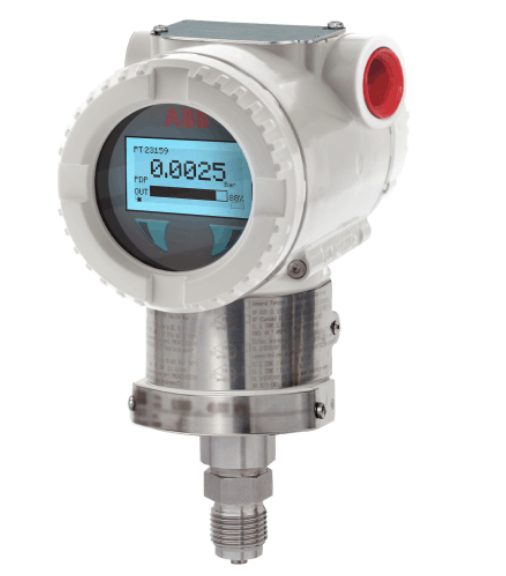
PGS100 is the cost-conscious choice for standard applications; PGS300 is the industrial reference platform; PGS500 addresses the most demanding requirements. PGP100 and PGF100 are specialist variants for pulp and paper and for food and pharmaceuticals.
Download PDFs for your model. IT or EN identifies the language. Select manuals to match the instrument's communication protocol.
P-100 family datasheet. Separate HART and IO-Link manuals.
Datasheet shared with PGD300, PAS300 and PAD300.
The family manual covers P-300 and P-500.
PGS500 datasheet on request. Contact us
P-100 and P-300 also differ in connectivity, diagnostics and application options.
P-100 is a robust platform for standard specifications. We select it where Ex d, higher accuracy or more complex industrial configurations are unnecessary.
A backlit display, advanced digital diagnostics, QR code and optional Bluetooth, plus a wider choice of materials and configurations for critical processes.
A P-100 variant dedicated to pulp and paper. Flush process connections help reduce crystallisation, blockage and possible diaphragm damage in typical industry applications.
A sanitary variant for hygienic applications, with dedicated process connections such as Tri-Clamp and specific food and pharmaceutical certifications.
The family guides migration, but an equivalent configuration always requires the full model code.
ABB 261GSABB 261GGABB 261GCABB 261GJABB 261GMABB 261GNABB 261GRABB 264GSABB 264GCABB 264GRABB 265GSABB 265GCABB 265GGABB 265GJABB 265GMABB 265GNABB 265GRABB 266HSHABB 266GSTOriginal documents for identifying installed versions. Check the full code and protocol on the nameplate.
Versions with direct-mounted seals.
2010 edition, also including 261GC, 261GG and 261GN.
264H/N/G/A HART family manual. Dedicated datasheets unavailable; send the full code for identification and spare parts.
Datasheet rev. 5 and earlier rev. 1.
Datasheet rev. 7 and earlier rev. 5.
Gauge pressure. Datasheet shared with 611ED, 611EE, 611EH and 611EA versions.
Gauge pressure; the document also includes absolute-pressure 614EA.
Gauge pressure. The EG suffix distinguishes this version from differential and absolute variants.
Gauge pressure; the document also includes absolute-pressure 624EA.
Select the gauge-pressure configuration in the document. Other configurations are covered separately.
Gauge-pressure versions with direct-mounted seals. Check the full code.
More information helps us check the configuration and replacement sooner.
266DSH.E.S.S.B.2.B.1.V2.E1.L1.C1.H3 — or the serial number, or a clear nameplate photograph showing both.
PGS100 is normally more competitive when budget is the priority, Ex d is unnecessary, HART is sufficient and accuracy of around 0.1% or 0.25% meets the application requirements.
PGS300 is the industrial choice for Ex d, greater robustness and accuracy, protocols beyond HART, or typical energy, oil, gas and chemical applications.
PGS500 suits critical processes or demanding specifications where performance takes priority over budget. PGS300 remains sufficient for many oil, gas and chemical applications.
PGP100 is dedicated to pulp and paper. Its process connections are designed to reduce crystallisation, blockage and diaphragm damage.
PGF100 is the sanitary variant for food and pharmaceuticals, with specific process connections such as Tri-Clamp and certifications for hygienic applications.
Older 261 gauge families are normally migrated to ABB P-100. Verify the exact model through the full code, serial number or nameplate.
264 and 265 gauge families are normally directed towards ABB PGS300. Verify the equivalent configuration against the full code.
266HSH corresponds to the industrial PGS300 class; 266GST corresponds to the top PGS500 class.
No. In older 611, 621 and 624 families, the following letters identify transmitter type and version. At least the full code, serial number or a nameplate photograph is required.