
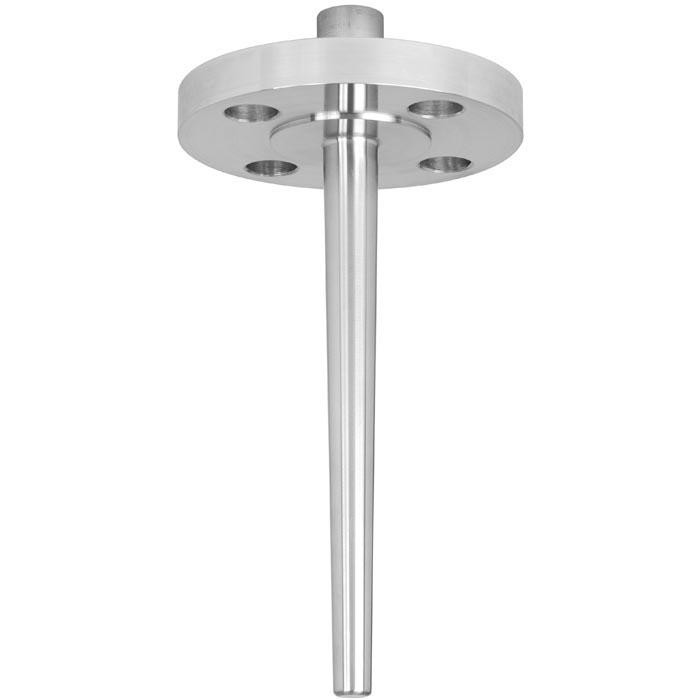
Flanged
Typical in industrial processes where flange standards, pressure and material are defined by the piping specification.
The thermowell is integral to the measurement point: it protects the sensor, allows maintenance without opening the process, and must be sized for pressure, velocity, material and flow-induced vibration.
Typical in industrial processes where flange standards, pressure and material are defined by the piping specification.
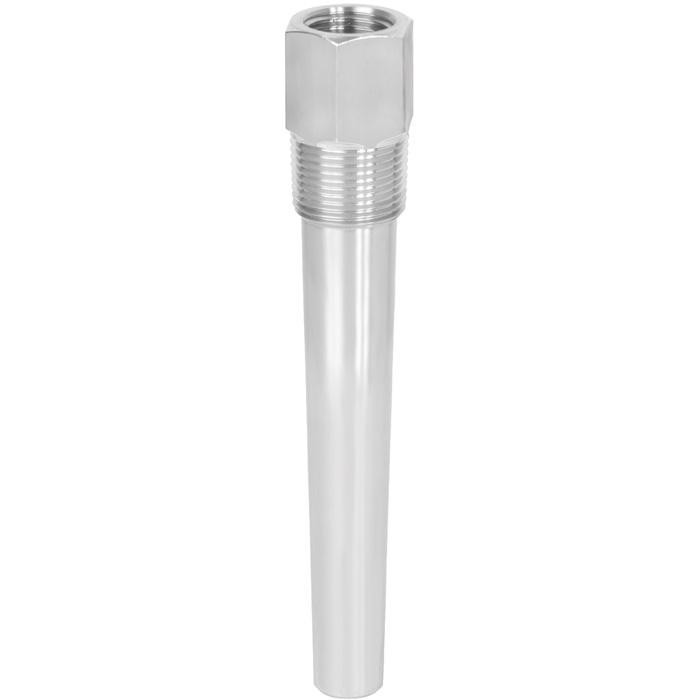
A compact solution for many industrial, utility and machinery applications where threaded connections are permitted.
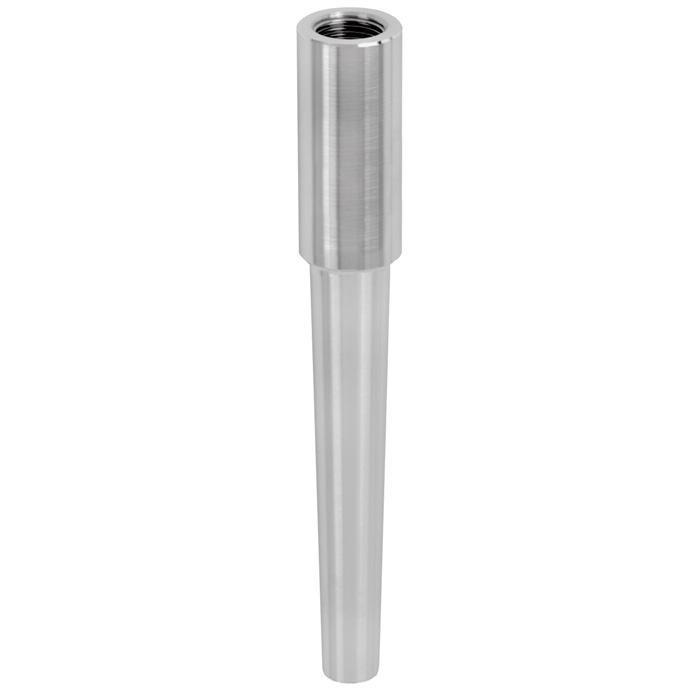
Used where the design requires a permanent, robust connection directly to the pipe or vessel.
This construction choice is independent of the process connection. Fabricated protection tubes are economical and suitable for many services. Solid-machined thermowells are normally preferred where pressure, velocity and dynamic loads require greater robustness and stricter mechanical assessment.
The most common choice for many industrial and utility applications.
Special materials for corrosion, temperature or particular project specifications.
Root and tip diameters, bore, insertion length and profile determine response and strength.
Fluid flow generates vortices that can excite a thermowell. For solid-machined thermowells with geometries within the standard's scope, an ASME PTC 19.3 TW-2016 wake-frequency calculation checks frequency ratio and static/dynamic loads.
Aluminium, stainless steel or specified materials, with terminal blocks or integrated head-mounted transmitters.
Separate the head from process heat and provide clearance over insulation or installation geometry.
Adjust insertion depth or adapt the sensor to the measurement point, with pressure and sealing checks.
RTDs use copper cables suitable for 2-, 3- or 4-wire connections. Thermocouples require correct extension or compensation cables for types J, K, T, N, E, R, S or B.
ABB SensyTemp assemblies can be supplied without a thermowell, with a welded protection tube or with a solid-machined thermowell, according to family and process conditions.
For new measurement points on metal pipes, consider the non-invasive NINVA TSP341-N solution.
Explore NINVAWhen the sensor requires protection from pressure, velocity, corrosion or mechanical loads and must be removable without opening the process.
A protection tube is fabricated from tubing and is more economical. A solid-machined thermowell offers greater robustness for more demanding process conditions.
It is important in demanding flow conditions to verify resistance to static and dynamic loads. Solid-machined thermowells are normally assessed under ASME PTC 19.3 TW-2016 where applicable.
Use copper cable suited to the 2-, 3- or 4-wire arrangement, temperature and environment. Lead resistance and shielding may be important.
Use extension or compensation cable compatible with the thermocouple type, observing polarity, material and temperature class.